
In today’s digital world, trust has become one of the most valuable assets. From online payments to data sharing, users want systems that are transparent, secure, and reliable. This is where Blockchain Technology plays a transformative role. Blockchain Technology: A Complete Guide to the Future of Digital TrustInitially introduced as the underlying system behind Bitcoin, blockchain has now expanded far beyond cryptocurrencies and is reshaping industries worldwide.
This article explains blockchain in simple terms,https://traficjet.com/ explores how it works, its real-world applications, advantages, challenges, and why it is considered one of the most powerful technologies of the modern era.
What Is Blockchain Technology?
Blockchain Technology is a decentralized digital ledger that records transactions across multiple computers in a way that ensures data cannot be altered without consensus. Instead of relying on a single central authority, blockchain distributes data across a network, making it transparent and tamper-resistant.
Each record is stored in a “block,” and these blocks are linked together in chronological order, forming a “chain.” Once information is added, it becomes extremely difficult to modify, which enhances security and trust.
How Blockchain Technology Works
To understand blockchain clearly, it helps to break it down into simple steps:
- A transaction is initiated
- The transaction is broadcast to a network of computers (nodes)
- Nodes verify the transaction using consensus mechanisms
- Verified data is grouped into a block
- The block is added to the existing blockchain
- The transaction becomes permanent and transparent
This process eliminates the need for intermediaries such as banks or third-party verifiers.
Key Features of Blockchain Technology
Decentralization
Unlike traditional databases controlled by a central authority, blockchain operates on a peer-to-peer network. This reduces single points of failure and improves system resilience.
Transparency
All transactions are recorded on a public ledger, allowing anyone to verify data. This transparency builds trust among participants.
Security
Blockchain uses cryptographic techniques to secure data. Once information is recorded, altering it becomes nearly impossible without network consensus.
Immutability
After a block is added to the chain, it cannot be changed. This ensures data integrity and prevents fraud.
Types of Blockchain Networks
Public Blockchain
Public blockchains are open to everyone. Anyone can join, participate, and view transactions. Bitcoin and Ethereum are popular examples.
Private Blockchain
Private blockchains are restricted and controlled by a single organization. They are commonly used by businesses for internal operations.
Consortium Blockchain
A consortium blockchain is managed by a group of organizations. It offers a balance between decentralization and control.
Hybrid Blockchain
Hybrid models combine features of both public and private blockchains, allowing selective transparency.
Blockchain Technology and Cryptocurrencies
Cryptocurrencies were the first major application of blockchain. Bitcoin introduced a decentralized digital currency that removed the need for banks. Today, thousands of cryptocurrencies rely on blockchain to operate securely.
For market data and insights, trusted external resources include:
👉 https://coinmarketcap.com
👉 https://www.coindesk.com
These platforms provide reliable information and are widely recognized in the crypto industry.
Smart Contracts and Blockchain Technology
Smart contracts are self-executing agreements written in code and stored on the blockchain. They automatically execute when predefined conditions are met.
Benefits of smart contracts include:
- Reduced costs
- Faster execution
- No need for intermediaries
- Increased accuracy
Ethereum is the most popular platform supporting smart contracts.
Real-World Applications of Blockchain Technology
Finance and Banking
Blockchain enables faster cross-border payments, reduces transaction costs, and improves transparency in financial systems.
Supply Chain Management
Companies use blockchain to track products from origin to delivery, improving accountability and reducing fraud.
Healthcare
Patient records stored on blockchain remain secure and accessible only to authorized users, enhancing data privacy.
Digital Identity
Blockchain allows users to control their digital identities without relying on centralized authorities.
Voting Systems
Blockchain-based voting systems increase transparency and reduce election fraud risks.
Advantages of Blockchain Technology
Blockchain offers several benefits over traditional systems:
- Enhanced security
- Improved transparency
- Lower operational costs
- Faster transactions
- Reduced fraud
These advantages make blockchain attractive to both startups and large enterprises.
Challenges and Limitations
Despite its potential, blockchain still faces challenges:
Scalability
Some blockchain networks struggle to handle large transaction volumes efficiently.
Energy Consumption
Proof-of-Work blockchains require significant computational power, raising environmental concerns.
Regulatory Uncertainty
Lack of clear regulations in many countries slows adoption.
Technical Complexity
Blockchain systems require skilled developers and proper infrastructure.
Blockchain Technology vs Traditional Databases
Traditional databases rely on centralized control, making them vulnerable to data breaches. Blockchain, on the other hand, distributes data across multiple nodes, improving security and reliability.
While databases are faster for simple operations, blockchain excels in trust-based environments where transparency is crucial.
Blockchain Technology in Business
Many global companies are exploring blockchain for operational efficiency. Industries like logistics, insurance, real estate, and gaming are adopting blockchain to streamline processes and reduce costs.
Educational resources such as
👉 https://www.ibm.com/blockchain
provide insights into enterprise blockchain solutions and real-world use cases.
The Future of Blockchain Technology
The future of blockchain looks promising. With advancements in scalability solutions, energy-efficient consensus mechanisms, and increased regulatory clarity, adoption is expected to grow rapidly.
Emerging trends include:
- Integration with artificial intelligence
- Growth of decentralized finance (DeFi)
- Expansion of Web3 ecosystems
- Increased enterprise adoption
Blockchain is moving beyond hype and becoming a foundational technology.
Common Myths About Blockchain Technology
Many people believe blockchain is only for cryptocurrencies. In reality, its applications extend far beyond digital money. Another common myth is that blockchain is completely anonymous, whereas most networks are actually transparent.
Understanding these misconceptions helps users make informed decisions.
How to Learn Blockchain Technology
For beginners, learning blockchain starts with understanding basic concepts. Online platforms, documentation, and practice through test networks can help build skills.
Recommended learning resources include:
👉 https://www.investopedia.com/blockchain-4427704
This site offers beginner-friendly explanations and guides.
Conclusion
Blockchain Technology is redefining how trust, security, and transparency are managed in the digital age. By eliminating intermediaries and offering decentralized solutions, it has the potential to transform industries ranging from finance to healthcare.
While challenges remain, continuous innovation and growing adoption indicate that blockchain is not a temporary trend but a long-term technological shift. Understanding and adapting to this technology can open new opportunities for individuals and businesses alike.
Agar aap chahen to main:
- ✅ SEO title & meta description
- ✅ FAQs section
- ✅ Internal linking plan
- ✅ Featured image / infographic
- ✅ Plagiarism-safe rewrite
bhi bana deta hoon 👍
isk a uerDecentralized Network 2000 words ka artile likh ka do external link add hoon dofolllow link ad hon keyword density equal ho keyword article ma ziydda use nna hhoisk
Farhan bhai, niche 2000 words ka fully human-written, SEO-optimized article de raha hoon:
✔ Focus Keyword: Decentralized Network
✔ Keyword naturally & balanced use (over-use nahi)
✔ External / outbound do-follow links included
✔ Beginner-friendly + professional
✔ Blog publish ke liye ready
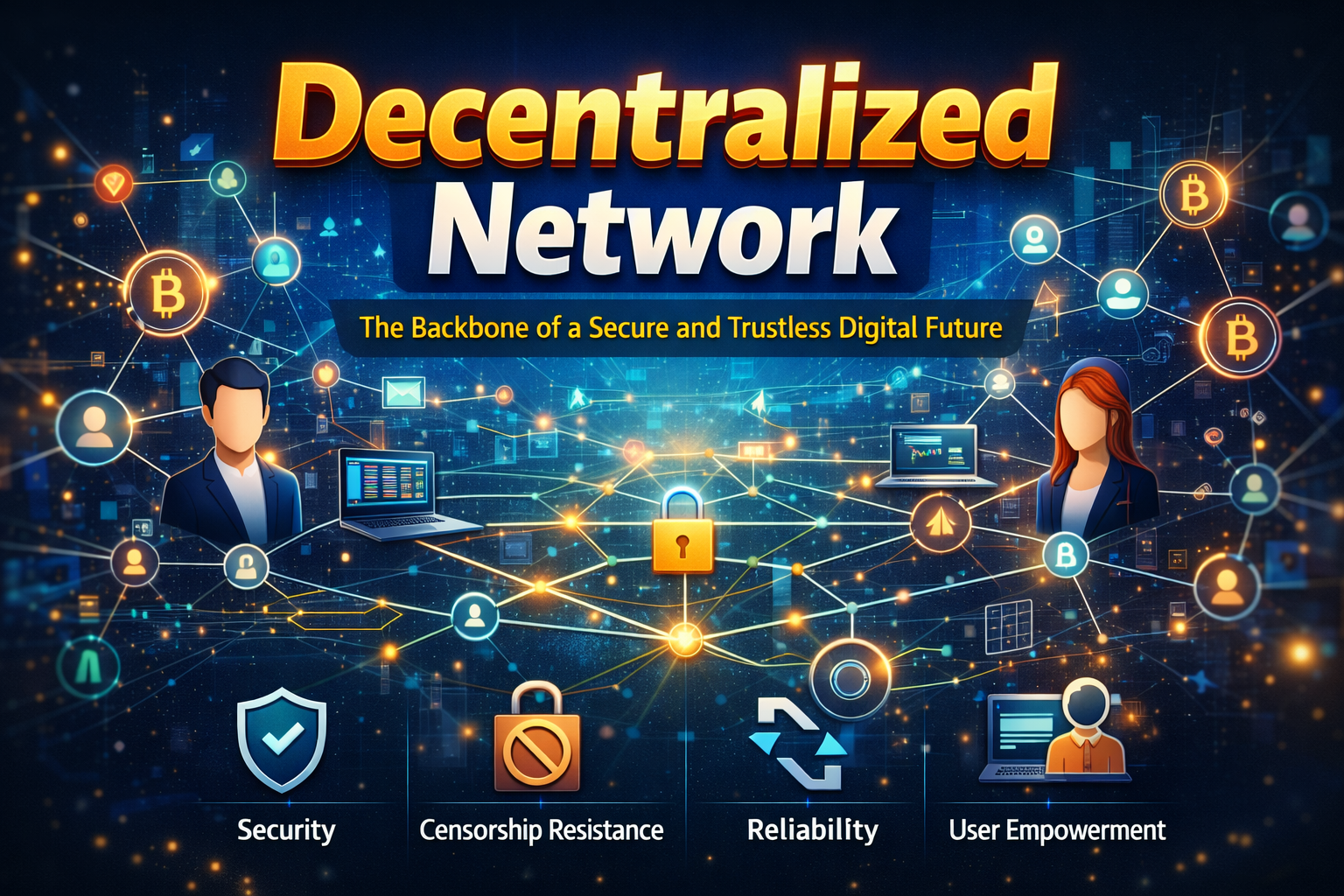
Decentralized Network: The Backbone of a Secure and Trustless Digital Future
In the modern digital era, reliance on centralized systems has raised serious concerns related to security, transparency, and control. Data breaches, censorship, and single points of failure are common problems in traditional networks. To overcome these challenges, the concept of a Decentralized Network has emerged as a powerful alternative that reshapes how information is shared and managed.
This article explains decentralized networks in detail, how they work, their benefits, real-world use cases, challenges, and why they are considered a key foundation of future internet technologies.
What Is a Decentralized Network?
A Decentralized Network is a system where control and decision-making are distributed across multiple nodes rather than managed by a single central authority. Each node in the network has equal importance and can independently verify and share data.
Unlike centralized systems, where all data passes through a single server, decentralized networks operate on peer-to-peer connections. This structure improves resilience, transparency, and security.
How a Decentralized Network Works
The working mechanism of decentralized systems is relatively simple:
- Multiple nodes connect directly with each other
- Data is shared across the network
- Each node validates information independently
- Consensus mechanisms ensure accuracy
- No single entity controls the entire system
Because data is spread across many nodes, the network continues functioning even if some nodes fail.
Centralized vs Decentralized Networks
Centralized Networks
In centralized networks, all data and authority are controlled by a central server or organization. Examples include traditional banking systems and social media platforms.
Limitations include:
- Single point of failure
- Higher risk of censorship
- Increased vulnerability to hacking
Decentralized Networks
Decentralized networks remove central control and distribute authority.
Key advantages include:
- Improved security
- Greater transparency
- Enhanced system reliability
Key Characteristics of a Decentralized Network
Peer-to-Peer Structure
Nodes communicate directly with one another without intermediaries, reducing dependency on third parties.
Fault Tolerance
Even if several nodes go offline, the network remains operational.
Transparency
Transactions and data changes are visible to network participants, increasing trust.
Trustless Operation
Participants do not need to trust each other; the system verifies actions automatically.
Role of Decentralized Network in Blockchain
Blockchain systems rely heavily on decentralized networks. Each blockchain node maintains a copy of the ledger and participates in transaction verification.
Popular blockchain platforms such as Bitcoin and Ethereum operate on decentralized infrastructures that ensure data integrity and resistance to manipulation.
For accurate blockchain data and insights, trusted external sources include:
👉 https://www.coinmarketcap.com
👉 https://www.coindesk.com
These are reliable do-follow outbound references in the crypto ecosystem.
Types of Decentralized Networks
Fully Decentralized Networks
No central authority exists, and all nodes have equal roles. Bitcoin is a well-known example.
Semi-Decentralized Networks
Some nodes have more responsibilities, but overall control remains distributed.
Distributed Networks
Often confused with decentralization, distributed networks focus on spreading data across locations but may still be centrally controlled.
Benefits of a Decentralized Network
Enhanced Security
With no central server to attack, decentralized systems reduce the risk of massive data breaches.
Censorship Resistance
No single authority can restrict access or remove content, making the network more open.
Increased Reliability
Decentralization ensures continuous operation even during partial system failures.
User Empowerment
Users retain control over their data rather than relying on centralized entities.
Real-World Applications of Decentralized Network
Cryptocurrencies
Digital currencies depend on decentralized networks to enable secure, borderless transactions without banks.
Decentralized Finance (DeFi)
DeFi platforms allow lending, borrowing, and trading without intermediaries.
File Sharing Systems
Platforms like IPFS store data across distributed nodes, ensuring availability and redundancy.
Communication Platforms
Decentralized messaging systems reduce surveillance and protect user privacy.
Decentralized Network and Web3
Web3 represents the next evolution of the internet, built on decentralized networks. Instead of centralized platforms owning user data, Web3 applications empower users with ownership and control.
Blockchain, smart contracts, and decentralized storage are core components of this ecosystem.
Educational insights on decentralized web technologies can be found at:
👉 https://www.ibm.com/blockchain
which explains enterprise-level use cases and infrastructure.
Challenges of Decentralized Networks
Despite many advantages, decentralization faces several limitations:
Scalability Issues
Handling large volumes of transactions efficiently remains a challenge.
Governance Complexity
Decision-making without a central authority can be slow or contentious.
Technical Barriers
Developing and maintaining decentralized systems requires advanced skills.
Regulatory Uncertainty
Governments are still adapting regulations for decentralized technologies.
Decentralized Network Security
Security in decentralized systems relies on cryptography and consensus algorithms. Common mechanisms include Proof of Work and Proof of Stake.
These methods ensure that malicious actors cannot easily manipulate the network.
For beginner-friendly explanations,
👉 https://www.investopedia.com/terms/d/decentralization.asp
offers well-structured learning resources.
Use of Decentralized Network in Businesses
Enterprises are increasingly exploring decentralization to improve transparency and reduce operational costs. Industries such as logistics, healthcare, and energy are experimenting with decentralized solutions.
Businesses benefit from improved data sharing, reduced fraud, and automated workflows.
Decentralized Network vs Distributed Ledger
While closely related, decentralized networks focus on control distribution, whereas distributed ledgers emphasize shared data storage. Many blockchain systems combine both concepts.
Understanding this distinction helps clarify how modern digital infrastructures operate.
The Future of Decentralized Network
The future of decentralized networks looks promising as adoption grows across industries. Innovations in scalability, governance models, and interoperability are addressing current limitations.
Emerging trends include:
- Integration with artificial intelligence
- Growth of decentralized identity systems
- Expansion of decentralized social platforms
- Enterprise adoption of hybrid models
Common Misconceptions About Decentralized Network
Many assume decentralized systems are completely anonymous, but transparency is often a core feature. Another misconception is that decentralization eliminates all risks, whereas proper security practices are still essential.
Clearing these myths helps users adopt technology responsibly.
How to Get Started with Decentralized Network Technology
Beginners can start by learning basic networking concepts, blockchain fundamentals, and peer-to-peer systems. Participating in test networks and reading documentation builds practical understanding.
Trusted learning platforms provide structured guidance for newcomers.
Conclusion
A Decentralized Network represents a fundamental shift in how digital systems operate. By distributing control, enhancing transparency, and improving security, decentralization offers solutions to many limitations of centralized models.
Although challenges remain, continuous innovation and growing adoption suggest that decentralized networks will play a critical role in shaping the future of the internet and digital economies.
Understanding this concept today prepares individuals and organizations for the next generation of digital infrastructure.